


Your shopping cart is empty!
Pumpkin "Amazonka"
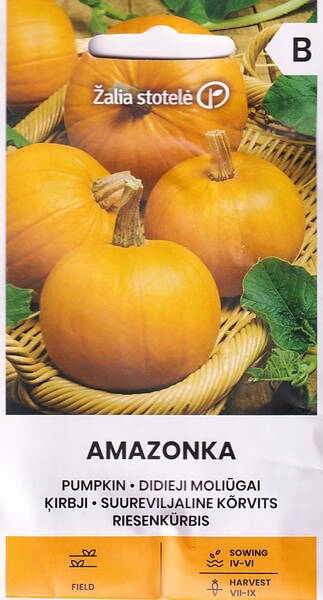
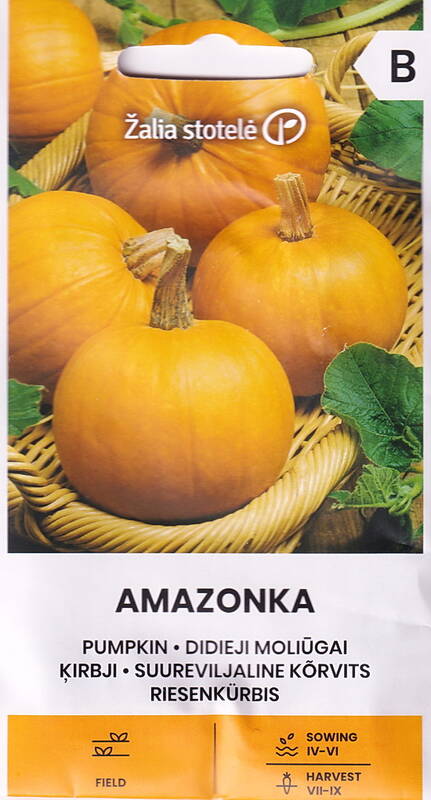
Portion Pumpkin "Amazonka".
An early-ripening bush variety. The period from emergence to full maturity is 80–88 days. The main vine grows up to 1 m.
The fruit is round, smooth, bright orange with faint white stripes. Weight 0.6–1.5 kg. The flesh is bright orange, crisp, and sweet.
Universal use.
An early-ripening bush variety. The period from emergence to full maturity is 80–88 days. The main vine grows up to 1 m.
The fruit is round, smooth, bright orange with faint white stripes. Weight 0.6–1.5 kg. The flesh is bright orange, crisp, and sweet.
Universal use.
* GROWING FEATURES.
Pumpkin is a heat-loving crop. It needs not only soil moisture but also air humidity. The crop has a powerful root system that goes deep into the ground. Pumpkin does not tolerate waterlogging, so it is best planted on higher ground. It grows прекрасно not only on regular soil but also on manure beds.
Choose a sunny planting location and fertile soil. Since pumpkin takes up a lot of space, it is best planted along a fence, guiding the vines onto it. Bush forms are grown in beds, placing the vines under trees.
Pumpkin seeds germinate slowly, and the plant itself develops over a long period (120–140 days). Therefore, it is best grown through seedlings. Start sowing for seedlings 25–35 days before transplanting outdoors.
It is better to sow not in boxes but in individual cups, as pumpkin does not tolerate transplanting well. Water seedlings with warm water (+25°C) and feed 1–2 times with mineral fertilizers (1 tablespoon per 5 liters of water).
In Estonia, seedlings are planted in beds on June 10–12, and under cover on May 20–25. It is better to plant them on raised beds (20–25 cm).
If you were not able to grow seedlings, sow the seeds directly in open ground (but not earlier than May 25). Pre-soak them in water or germinate them in moist sawdust until a small root tip appears. Seed sowing depth is 8–12 cm.
CARE.
Pumpkin care includes watering, feeding, loosening, mulching the soil, and shaping the bush. Watering is not frequent, but abundant.
During flowering, watering is slightly reduced. To avoid washing pollen off the flowers, water at the root, into the planting hole. Two weeks after planting, feed the plants with mullein infusion (1 bucket per plant) mixed with diluted nitrophoska (2 tablespoons). Repeat feeding after 15 and 30 days.
If pumpkin vines are not pinched, they can grow 5–7 meters long. A lot of nutrients will go into leaf growth, many small pumpkins will set, and they will not have time to ripen.
To obtain a good harvest, the plant should be formed into 1–3 stems, leaving 1–2 fruits on each. When the main stem reaches 1.5–2 meters in length and has 1–2 ovaries, pinch the tip of the vine, leaving 4–5 leaves after the last ovary. Leave 1–2 side vines and remove the rest. The remaining vines can be sprinkled with soil and pinned down. They root easily, and then the fruits receive much more nutrition and ripen faster.
Pumpkins are harvested in dry weather from September 1 to 15, cutting them together with the stem. Never lift a pumpkin by the stem — it may break off, and during storage the pumpkin may rot. Optimal storage temperature: five to eight degrees. Pumpkins also store well at room temperature without direct sunlight. If proper storage conditions are not available, pumpkins are processed: frozen, dried, made into jam and candied fruit. The best fruits are kept until spring for seeds.
* Pumpkins were first domesticated in the 3rd millennium BC in what is now Peru and Mexico, from where they were brought to Europe (and also to India) by the Portuguese in the early 16th century. After that, pumpkins quickly spread across many countries. The tastiest fruits belong to butternut squash. They most often have an elongated shape, sometimes with a narrowing, and a pinkish-brown or yellow color in various shades. Unfortunately, this type takes a long time to mature, so its cultivation is limited.
Large-fruited pumpkin varieties produce big fruits (up to 50 kg), white or gray, flattened or round. Common pumpkin has oval-cylindrical fruits of yellow-orange color, sometimes with a yellow-green pattern. This group also includes small decorative pumpkins with фигурные fruits and unusual patterns.
Pumpkin is very healthy. It contains many salts of potassium, phosphorus, calcium, iron, magnesium, copper, cobalt, and silicon. The yellow color of pumpkin is due to a large amount of carotene (provitamin A). Some varieties contain up to 40 mg/100 g of this vitamin. Pumpkin also contains vitamins C, B1, B2, B6, E, and PP.
Pumpkin is very well digested by the body because it has a relatively low amount of plant fiber in the edible part and a high water content.
Pumpkin contains up to 8–10% sugars and little acid, making it perfect for preparing various sweets (candied fruit, fruit leather, etc.).
Pumpkin can be stored fresh until spring at room temperature, but only if there is not a single повреждение on its surface. Otherwise, pumpkin should be stored in dry ventilated rooms at a temperature not exceeding +3°C.
Many nutritious and filling dishes are made from pumpkin. Pumpkin can be fried or boiled (after boiling, pumpkin should be drained in a colander so the taste does not worsen), but it is even better to stew it in its own juice or with a small amount of water. In Russia, millet porridge with pumpkin is especially popular. Rice porridge is also cooked with pumpkin. Still, pumpkin is tastiest and healthiest raw. For example, it can be grated coarsely, mixed with dried fruits, add nuts, honey, lemon zest, and dress with sour cream — you will get an amazing salad.
Not only the pumpkin flesh is eaten, but also the seeds, which have many benefits. Pumpkin seeds are flat, 1–3 cm long, with a yellowish-cream оболочка. They contain up to 52% fatty oil and up to 28% protein. Dried pumpkin seeds can replace almonds in confectionery and can also be added to salads to increase nutritional value. Pumpkin seed oil is produced from the seeds.